Run the whole studio on one system. It stays yours.
The schedule, your clients, payments, payroll, marketing, teacher training and the network, behind one login. Your prices, your brand, your client list, and your own Stripe account that GetEYT never sits between.
Every screen in the walkthrough is real and clickable. No sign in, no form first.
Runs the studio. Ten areas and four tabs across the top, which is everything a studio runs.
Down the side
- Today
- Schedule
- People
- Money
- Team
- Training
- Grow
- Setup
- The network
- Learning the platform
Across the top
- Home
- Front desk
- Inbox
- Sell at the desk

Runs the door. The same console opened by a front desk login, and every area in it is about the counter.
Down the side
- Check in
- Schedule
- Messages
- Find a member
- Quick sale
- Payments
- Memberships
- Reports
- Settings

Teaches. Their own classes, their own students and their own pay, and nobody else's.
Down the side
- Today
- My schedule
- Rosters
- Substitutions
- My students
- Class notes
- My certification
- Trainees I mentor
- My pay
- Settings

Books classes on their own phone. A separate account, never the studio console, with two extra tabs for a teacher training student.
Down the side
- Today
- Book a class
- Membership
- Library
- My training
- Coursework
- Ask EYT
- Settings

Headquarters. Every studio rolled up, with the ownership view underneath it. Only headquarters signs in here.
Down the side
- Network
- Onboarding
- Money
- Standards
- Grow
- People
- Ownership
- The network
- Support
Across the top
- Network overview
- Studios

A reformer breaks on a Tuesday.
4 peopleOne person types one thing. Four other people find out before the 6:00 AM class, and nobody makes a phone call. Every screen below is a crop of the walkthrough you can open yourself.
- 01
Maria, who owns the studio
Schedule
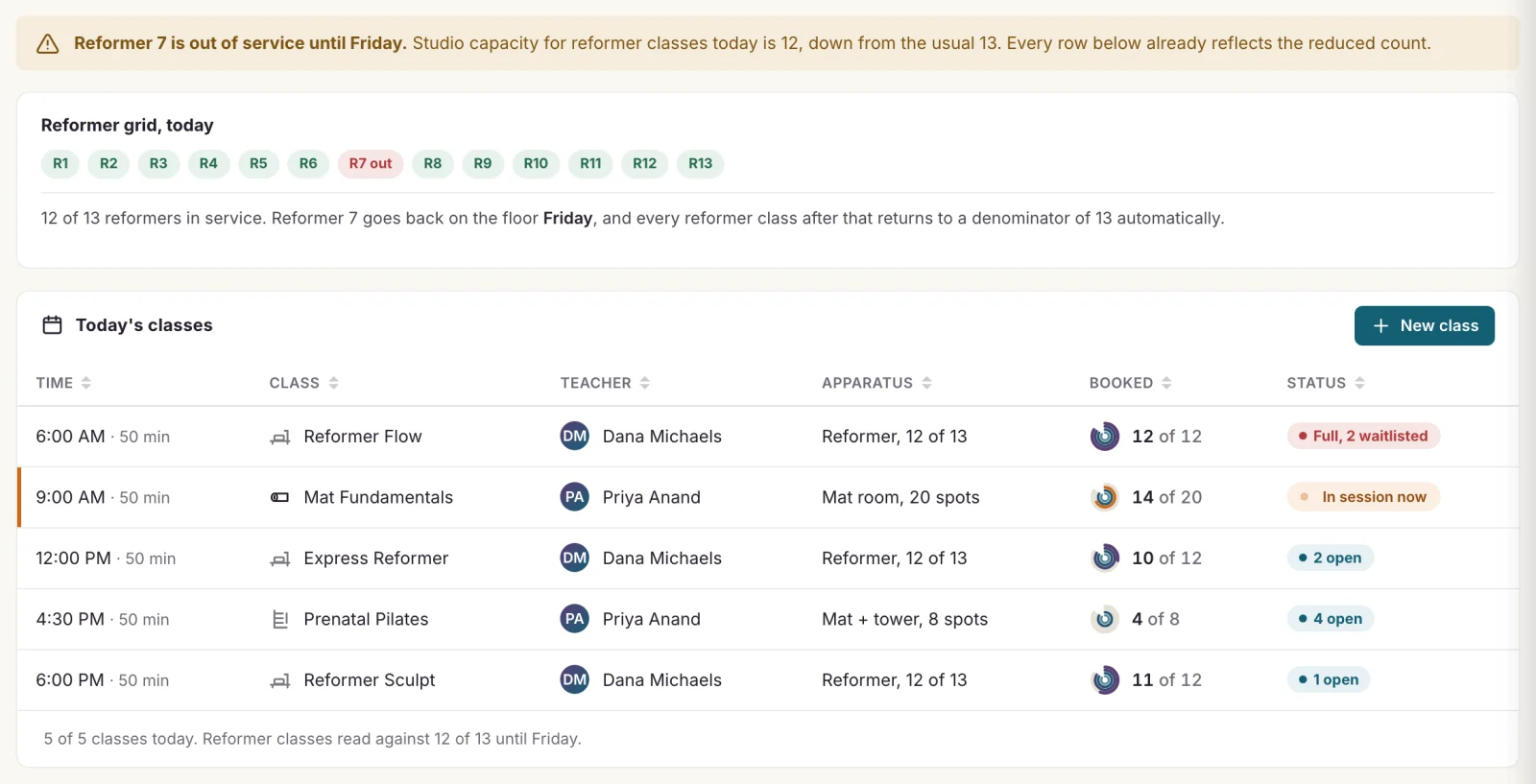
Marks Reformer 7 out of service until Friday.
That is the only thing anyone types. Every reformer class today re-reads against 12 instead of 13, and the 6:00 AM Reformer Flow turns over from one spot left to full, two waitlisted. It returns to 13 on Friday on its own.
- 02
Dana, who teaches it
Rosters
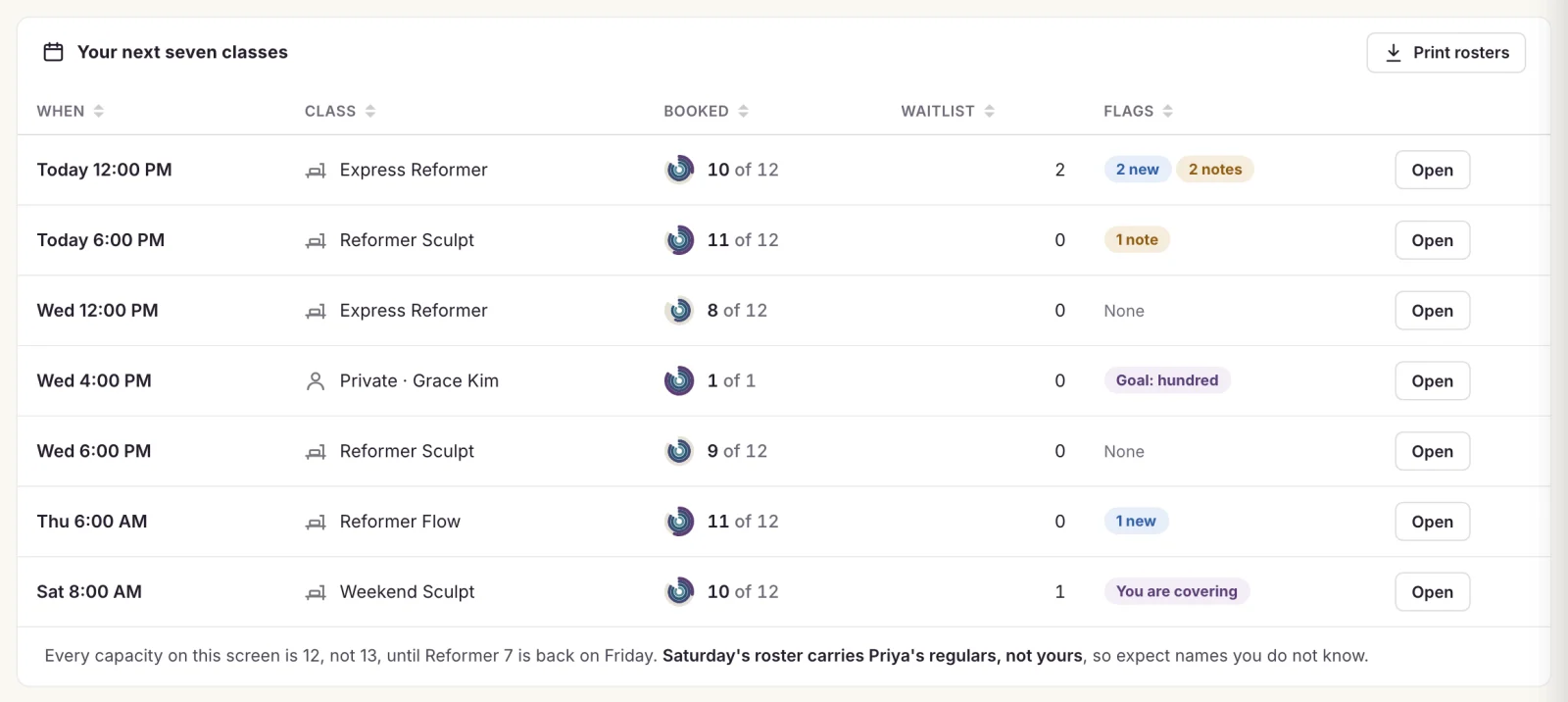
Opens her own rosters, the same as any other morning.
Her next seven classes are already capped at 12, and the screen says why. Nobody texted her, nobody remembered to. She teaches at more than one studio and this is the one where the machine broke.
- 03
Sam, who is on the desk
Check in
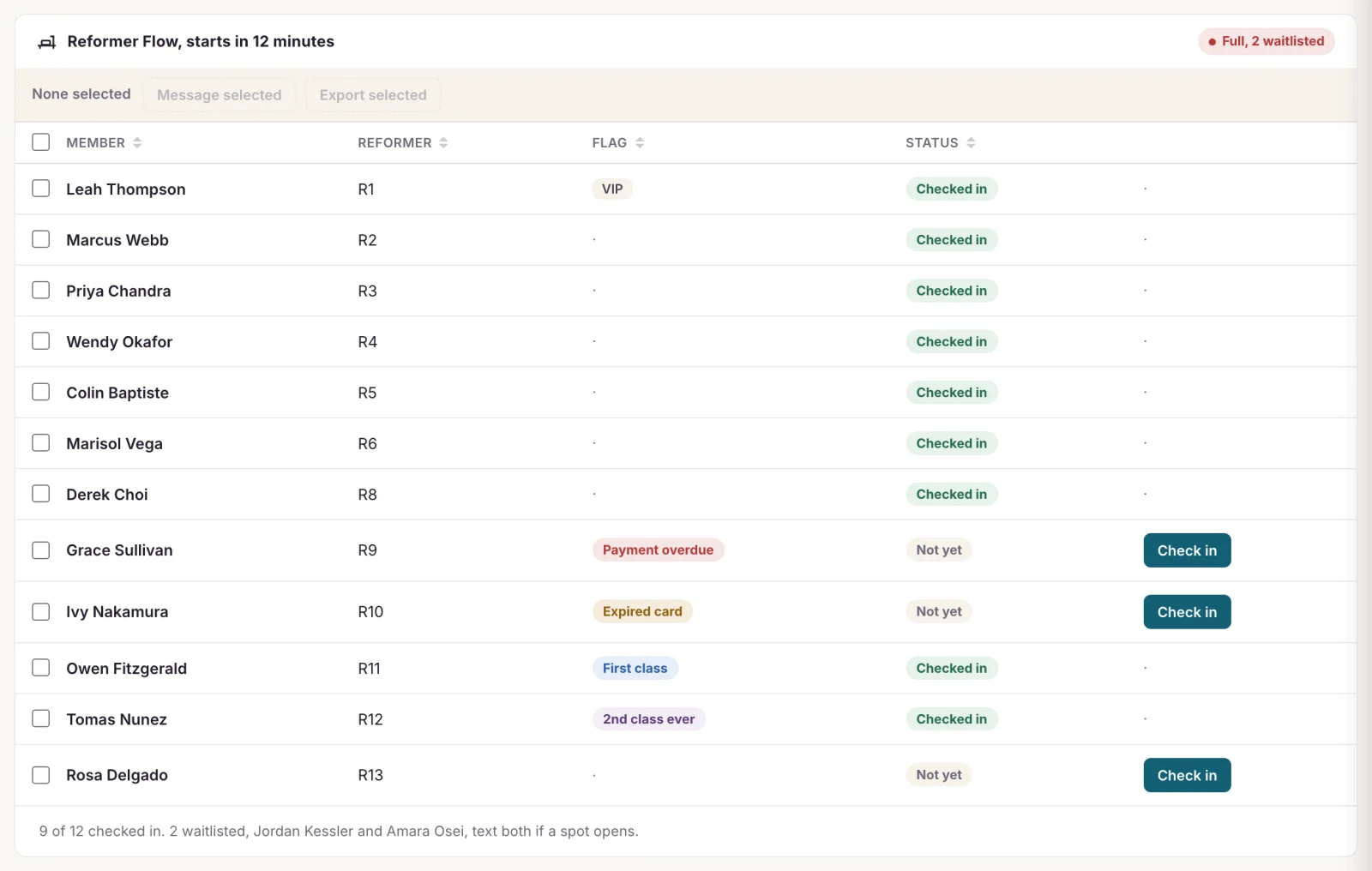
Opens the shift screen twelve minutes before the class.
Twelve names against twelve reformers. R7 is not on the list to assign somebody to by mistake. Two people are flagged before they reach the counter, one overdue and one on an expired card, and the two waitlisted names are on the same screen.
- 04
The member who was thirteenth
Waitlist
Booked, at some point last week.
Sits on the waitlist instead of arriving at six in the morning to a room with no machine for them. If somebody drops, the desk can see who to offer it to without opening anything else.
Today that is a text to the instructor, a sticky note on the desk, and one member standing in a studio at six in the morning. It is not that the other software gets this wrong. It is that the schedule, the roster, the desk and the money are four different companies, and not one of them knows a reformer broke.
Five separate bills, and not one of them knows the others exist.
5 bills| What you pay for | What it holds | Knows about the other four |
|---|---|---|
| Booking software | Your schedule, your clients, their packs | No |
| Email marketing | Your list, and who opened what | No |
| Surveys and forms | What people told you on intake | No |
| Website hosting | The page a client books from | No |
| Video hosting | The classes people watch at home | No |
| GetEYT | All five, and they read each other | One system |
A studio is not choosing between this and nothing. It is choosing between this and the stack it already pays for, five times over, in five places that do not talk.
Every other platform in this category says it was built for studio owners.
4 things you keepThat is a claim about who wrote it. These are claims about what you still hold afterwards, and each one is on a screen you can open right now.
- Your moneyYour studio connects its own Stripe account and is the merchant of record. Payouts land in your bank, the dashboard and the disputes are yours, and GetEYT never sits between you and your cash.
- Your pricesYou set them. Nothing about joining the network changes what you charge.
- Your brandYour studio's own name, your own site, your own clients. They book from you.
- Your client listIt moves with you, and it moves back out the same way. We do the moving by hand, one studio at a time, so nothing is guessed.
None of that is a favour and none of it is a term that can be revised later. It is how the software is built, and the walkthrough is open so you can check it rather than take it.
All four are already written. The staging is a release calendar, not a build calendar.
4 phasesNobody is waiting on code. Twenty studios are not being handed four new systems in one week, which is Jessica's own reasoning and it is the right one. Each phase also needs the one before it: marketing needs a client list, training needs studios that are running, the network needs something to trade.
| Phase | Name | Turns on | What turns on |
|---|---|---|---|
| 1 | Run the studio | September 1 | Clients, booking, the schedule, memberships, packs, payments, the front desk, payroll. Plus Chat EYT. |
| 2 | Fill the classes | Late September | Newsletters, text blasts when a class is under booked, the lead pipeline, the studio's own site and blog, review requests, an on demand library. |
| 3 | Teach the method | Late October | The EYT certification as software. Modules, auto graded quizzes, practical submissions, the curriculum and the written standards. |
| 4 | Own the network | Late November | The owners' board, a catalogue one studio's product is sellable by all of them, and the royalty accounting underneath it. |
Dates proposed, not confirmed. Jessica sets them. Phase 4 is visible from day one, read only, before it can be traded in. It is the reason the network exists and hiding it until November would be the wrong order.
The questions that actually get asked.
6 answers- Does it cost anything to join the network?No.
- What happens to my client data?It moves with you. We do the moving by hand, one studio at a time, so nothing is guessed. There is no automated importer and we are not going to pretend there is.
- Do I have to switch off my current software on September 1?No. Phase 1 turns on then. You move when you are ready.
- Can I keep my own prices?Yes. Your prices, your brand, your clients. Nothing about that changes.
- What does the software cost per month?Not set. It is being worked out with the owners rather than announced to them, and this site will carry the number the day it is decided.
- Is anything shared across studios?That is exactly the kind of thing the owners should decide together, and it is on the list. Nothing has been decided, so nothing is being done.
What is not connected yet is listed in full on theupdates page, with what it blocks.
Open it before you decide anything.
Every screen is clickable without a login, and the names and numbers inside are examples. If it holds up, the next step is a short conversation about your studio rather than a contract.